

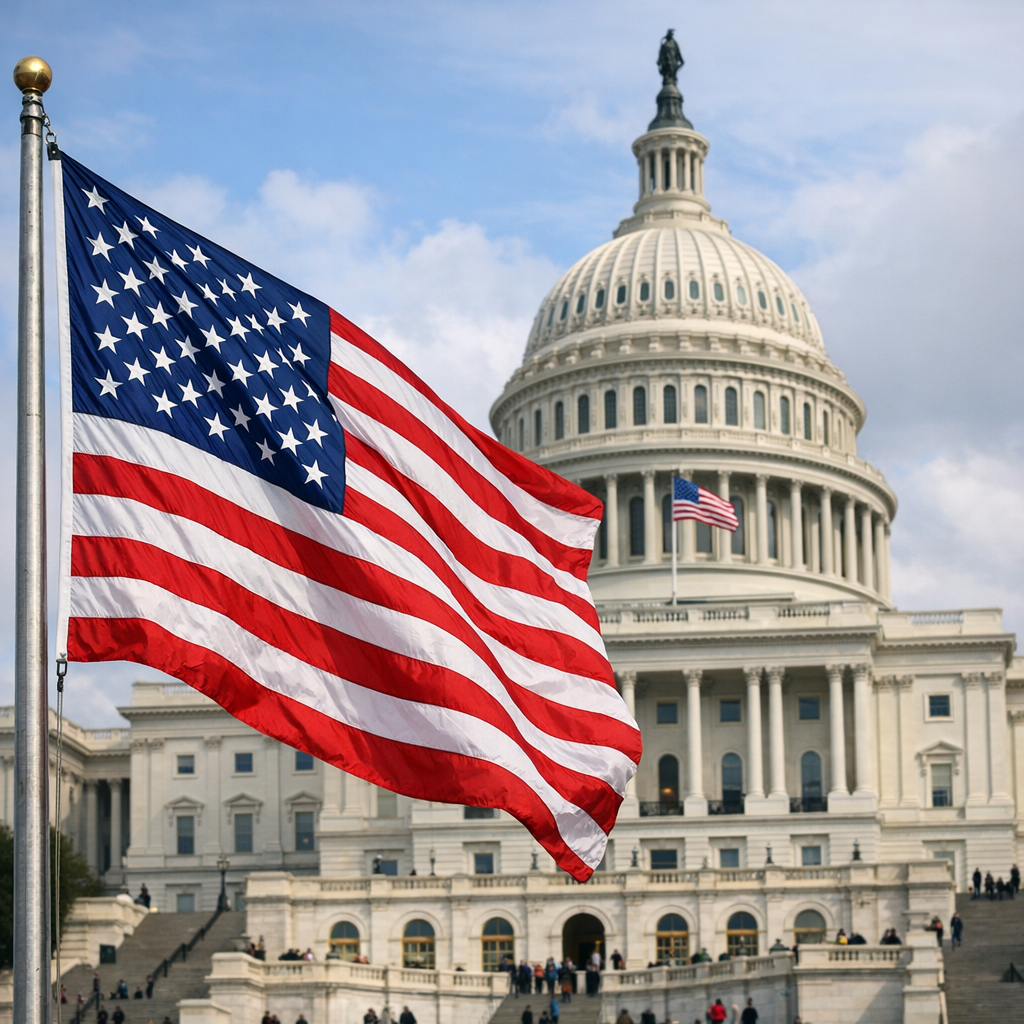
The United States operates as a federal presidential constitutional republic, characterized by a separation of powers among three branches: the Executive, Legislative, and Judicial.
Political Structure
The Executive Branch is led by the President, who serves as both the head of state and government. The Legislative Branch consists of a bicameral Congress, comprising the Senate and the House of Representatives. The Judicial Branch is headed by the Supreme Court, which interprets laws and ensures they align with the Constitution.
While the U.S. Constitution does not explicitly mention political parties, they have become integral to the political landscape. The two dominant parties are the Democratic and Republican parties, though third parties occasionally influence elections and policy debates.
Economic Overview
The U.S. boasts a highly developed and diversified market-oriented economy, ranking as the world’s largest by nominal GDP. In 2025, the GDP reached approximately $30.8 trillion, with a real GDP growth of 2.2% from the previous year. This growth aligns with the long-term economic potential derived from productivity and labor force expansion.
Key sectors contributing to the economy include technology, manufacturing, finance, and healthcare. The U.S. is also a leading producer of petroleum and natural gas, underscoring its significant role in global energy markets.
Trade plays a vital role, with major partners including Mexico, Canada, China, Japan, and Germany. In 2025, the trade deficit stood at $901 billion, reflecting the balance between imports and exports.
The labor market remains robust, with an unemployment rate hovering around 4.3% as of April 2026. Average hourly earnings have seen a steady increase, reaching $37.41 in April 2026.
Understanding the U.S. political system and economic landscape provides valuable insights into the nation’s global influence and internal dynamics.